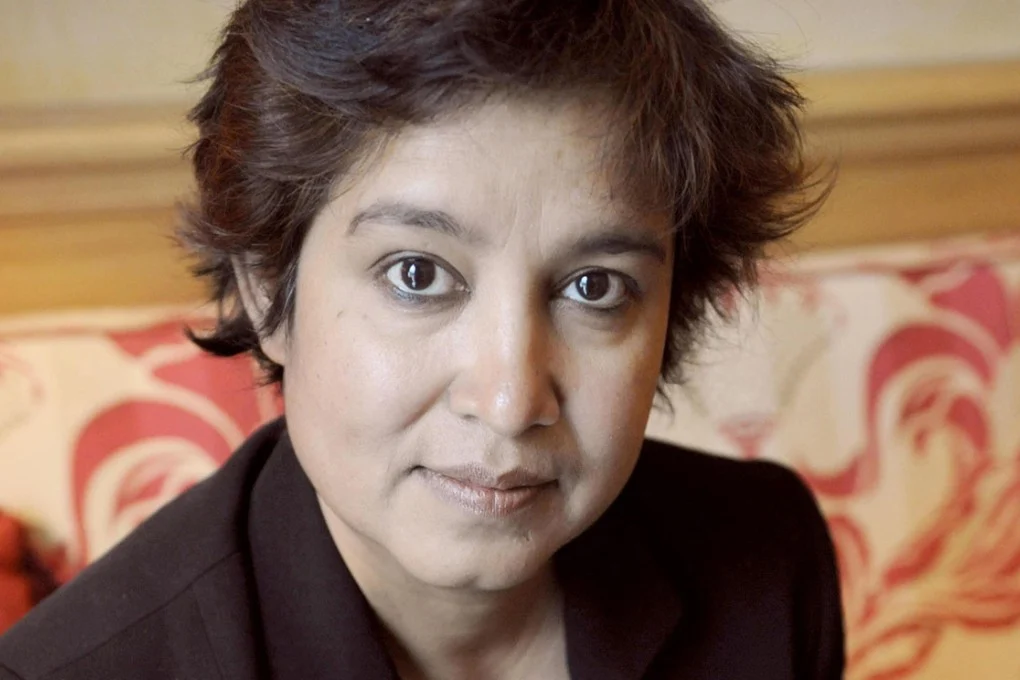
Taslima Nasrin —
A Warrior We Admire
Taslima Nasrin has spent thirty-two years without a country that will keep her. In August 2026 she returns to the one city she calls home.

Few writers in South Asia have been so thoroughly defined by their homelessness. Taslima Nasrin trained as a gynaecologist in a provincial Bangladeshi town, came to fame in the late 1980s as a newspaper columnist with an unsparing eye on the treatment of women, and by 1994 had become the most hunted author of the subcontinent’s post-Rushdie decade. A single novel and a misreported sentence turned her into a fugitive from her own country; three decades of wandering turned her into a permanent test case for how liberal societies handle a dissident who criticises religion without flinching.
This report traces that arc: the making of the writer, the book and the fatwa that unhoused her, the geography of her exile, the years in Kolkata that ended in expulsion, the machinery of threat and prohibition that has followed her across two nations, and the precarious legal thread by which she has held on to a home in India. It closes with the event that has returned her to headlines in the summer of 2026 — a homecoming to Kolkata made possible by a political reversal she could not have engineered, and one that has reopened every old argument about free speech, faith and the uses to which a banned writer can be put.
A doctor who could not look away
Mymensingh to Dhaka, 1962–1990
Born on 25 August 1962 in Mymensingh, then part of East Pakistan, Nasrin was the daughter of a physician father and a devoutly religious mother. She followed her father into medicine, taking her MBBS from Mymensingh Medical College in 1984 and working as a government doctor — in family planning, in gynaecology wards, in the delivery rooms of public hospitals. It was clinical work that supplied her first material as a writer. She has described treating girls who had been raped and hearing women weep at the birth of a daughter, and it was against that backdrop that she began, in 1989, to write newspaper columns drawn from what she saw.
The columns were confrontational from the start. She wrote about the subjugation of women, about religious sanction for that subjugation, and about a society she considered organised around men’s comfort. Raised in a Muslim family, she had by then become an atheist, and her prose refused the deference that Bangladeshi public life expected of a woman writing on these subjects. Her hair was short, she smoked, she declined traditional dress — and the affront, to conservative readers, was as much in the person as in the page. Bookshops in Dhaka that stocked her work were attacked as early as 1992. When the state later ordered her to choose between her hospital post and her writing, she resigned from public service and wrote full time.
Lajja, and the price of a sentence
1993–1994
In February 1993 Nasrin published Lajja — “Shame” — a short, fact-driven novel that followed a Hindu family through the wave of communal violence that swept Bangladesh after Hindu nationalists demolished the Babri Masjid in Ayodhya, India, in December 1992. The book catalogued the attacks, lootings and killings visited on Bengali Hindus in the aftermath, and it framed that persecution as the predictable product of a rising religious politics. It became a bestseller. The Bangladeshi government banned it, arguing it could inflame communal tension; Islamist groups read it as an assault on the faith itself.
The confrontation escalated in the spring of 1994 around a single reported sentence. An Indian newspaper, the Calcutta Statesman, quoted her as saying the Qur’an should be revised. Nasrin insisted she had been misreported — that she had called for revision of the sharia, the body of religious law, to give women more freedom, not of the scripture. The clarification came too late. Hundreds of thousands demonstrated; Islamist parties called a nationwide strike; a militant faction threatened to loose thousands of snakes in the capital unless she was executed. A fatwa demanded her death, bounties were placed on her head, and the government, invoking a nineteenth-century blasphemy statute, sought her arrest.
Her case was immediately read against Salman Rushdie’s: another South Asian writer under a religious death sentence, another test of whether the democratic world would defend an author it found inconvenient. But her defenders were not only Western. Secular intellectuals inside Bangladesh sheltered and campaigned for her during the months in hiding; Muslim writers in other countries published in her defence; even Iranian feminists spoke up. The pattern is worth holding on to: from the beginning, the line of division was never simply Islam against a lone apostate, but a religious-political movement against a coalition that included many believers.
Thirty-two years, charted
The recurring rhythm — welcome, backlash, expulsion
Daughter of a physician; trains in medicine and qualifies MBBS in 1984.
Newspaper writing on women’s oppression draws a following — and the first attacks on bookshops by 1992.
The novel on anti-Hindu violence becomes a bestseller and is prohibited in Bangladesh.
A death sentence and bounties; two months in hiding; escape into European exile. Awarded the Sakharov Prize the same year.
Sweden, Germany, France and the United States. Bangladeshi passport revoked; granted Swedish citizenship.
Moves to India on a renewable residence permit, settling in the Bengali-speaking city she loves.
Assaulted at a Hyderabad book launch in August; a Kolkata fatwa revived; forced out of West Bengal in November.
Months of confinement in Delhi; leaves India for the US; later returns, settling in Delhi on an annually renewed permit.
Her Indian residence permit lapses amid bureaucratic limbo and turmoil in Bangladesh; renewed after the Union Home Minister intervenes.
After a change of government in West Bengal, she returns on 1 August for an anti-fundamentalism event — her first major public visit in nearly two decades.
Four continents, no citizenship of return
The route of a stateless decade and its aftermath
After 1994 Nasrin lived for roughly ten years across Western Europe and North America — Sweden first, then Germany, France and the United States — holding fellowships, publishing, and campaigning while her Bangladeshi passport was revoked and Swedish citizenship took its place. The map of her life is not a map of choice. Each move was shaped by where she was permitted to be, and by the reach of the threat that followed her.
Crimson nodes mark the two cities she has called home. No Bangladeshi government has allowed her to return.
The city nearest her heart
2004–2007
Nasrin’s attachment to Kolkata is linguistic and emotional: it is the great Bengali-speaking city outside the country that exiled her, close enough to Bangladesh to feel like proximity to home. In 2004 she moved there on a residence permit issued by India’s central government, and for three years she lived and wrote quietly, publishing in Indian newspapers and taking part in the city’s literary life. It was, by her own account, the closest thing to belonging she had known since 1994.
It did not hold. Even before her arrival the Left Front government then ruling West Bengal had banned her memoir Dwikhandito (“Split in Two”), citing the risk of communal tension. Clerics in Kolkata revived and renewed threats against her. The breaking point came in 2007. In August, at a book launch in Hyderabad for the Telugu translation of her novel Shodh, she was attacked by a mob led by legislators of a regional Islamic party; organisers shielded her and she escaped, but the assault made national news. Days later, Kolkata clerics offered money for her death. By November she had been placed under effective house arrest and moved out of West Bengal — first to Jaipur, then to Delhi, where she spent months in confinement before leaving India altogether in 2008.
The politics of that expulsion have proved durable. The Left Front removed her; when the Trinamool Congress under Mamata Banerjee later came to power, it too declined to facilitate her return, citing security, cancelling literary events tied to her, and halting the broadcast of a television serial she had written. For close to two decades, no West Bengal government of any stripe was willing to have her physically present in the state — a bipartisan reluctance she has read as capitulation to the very forces that hounded her.
A ledger of the ban and the bounty
How two states and a movement have tried to silence one writer
The instruments used against Nasrin are worth naming precisely, because they are the same instruments used against freethinkers across the region: the fatwa and the cash bounty on one side, the blasphemy statute and the administrative ban on the other. The threat has been religious-political; the enforcement, at crucial moments, has been governmental. That combination — street pressure legitimised by state prohibition — is the machinery this report is concerned with.
Several of her autobiographical volumes — Amar Meyebela, Utal Hawa, Ka and its sequel — were banned by the Bangladesh government; Ka was also banned in West Bengal, though the Calcutta High Court later overturned that ban. The prohibition, in other words, has not been the work of mobs alone. Courts, home ministries and elected governments have all, at various points, been part of the apparatus that kept her books off shelves and her body out of Bengal.
Fifty years of writing, thirty languages
Poetry, columns, novels, and a multi-volume life
Nasrin began writing at thirteen and has never been a single-genre writer. Her output spans poetry collections, essay collections such as Narir Kono Desh Nei (“Women Have No Country”), the novels that made her name, and an unusually candid multi-volume autobiography that has itself repeatedly triggered bans. Her work has been translated into more than thirty languages. The through-line is a refusal of euphemism: on the position of women, on the authority of religious law, and on the communal violence she has witnessed, she writes without the softening most public discourse demands.
That uncompromising register is exactly what the honours below recognise. The European Parliament’s Sakharov Prize, awarded in the same year she fled into exile, framed her not as a victim but as a laureate of free thought — a distinction that has shadowed her ever since, as governments that praise the principle have proved reluctant to house the person.
A home renewed one year at a time
The bureaucracy of belonging, 2004–2024
For a writer who calls India her only home, Nasrin’s legal footing there has been strikingly thin. A Swedish citizen since the 1990s, she has lived in India not as a permanent resident but on a residence permit renewed by the Union Home Ministry — continuously since 2004, but often for a single year, and at least once for a mere three months. She has applied repeatedly for longer terms, and for permanent residency, without success. On more than one occasion she has appealed publicly, on social media, to home ministers to extend her stay.
The most acute scare came in 2024. Her permit lapsed; the online renewal portal stalled indefinitely on an “updating” status; and the limbo coincided with political upheaval in Bangladesh, where the government of Sheikh Hasina fell that August amid mass protests. For a stateless-in-practice writer barred from her country of origin, the prospect of losing her Indian foothold was existential. The matter was resolved only after the Union Home Minister intervened and the permit was renewed. It is a revealing detail: the security of the subcontinent’s most famous free-speech dissident has depended, again and again, on the discretion of the government of the day.
When Sheikh Hasina fled Bangladesh in August 2024, Nasrin noted the irony publicly: the same Islamist forces that, she argues, had pressured Hasina into keeping her in exile were among those whose movement ultimately drove Hasina from power. Her point was not triumph but warning — that a politics of accommodating fundamentalism tends, in the end, to consume the leaders who practise it.
Back to Rabindra Sadan
Why the door to Kolkata opened — and who is holding it
On the night of 31 July 2026 Nasrin is due to arrive in Kolkata, and on 1 August she is scheduled to appear at a public programme at Rabindra Sadan — poetry, discussion and a civic reception organised around the theme of resisting religious fundamentalism. For a writer forced out of the city in 2007 and kept away for nearly two decades, it is a homecoming of real weight. It is also inseparable from a political earthquake she played no part in.
In the 2026 West Bengal assembly election, the Bharatiya Janata Party won a decisive majority — roughly 206 seats of 294 — ending fifteen years of Trinamool Congress government and forming the party’s first-ever administration in the state. Suvendu Adhikari, a former Trinamool leader who defected to the BJP, was sworn in as Chief Minister on 9 May 2026. It is under this new government that the state is extending security for her visit, and that leaders once in opposition are welcoming her return as a rebuke to what they cast as the previous regimes’ appeasement of religious sentiment.
That symmetry is the heart of the controversy. Supporters across the spectrum frame the visit as a belated victory for literary freedom. Critics question its timing and choreography, warning that in Bengal’s polarised climate an anti-fundamentalism event blessed by the ruling party can become an instrument rather than a principle. Nasrin herself has pushed back sharply against both framings. She insists the event is organised not by any party but by a secular body — the Secular Mission, which she describes as led by a progressive Muslim — and that the state is merely discharging its routine duty to provide her security. She has rejected the Left’s characterisation of her as a Hindu-nationalist ally, pointing out that she has been welcomed under Communist governments in Kerala with high-grade protection, and that the same Bengal leaders now branding her a partisan were the ones who expelled her.
Both things can be true at once: that her return is a genuine milestone for free expression, and that it is being metabolised by a political machine for which her story is useful. The discomfort of that overlap is precisely what makes the moment worth reporting carefully rather than celebrating simply.
Ideology, adherents, and the line between them
A note on how to read Taslima Nasrin
It would be easy, and wrong, to file this story under a simple heading: Islam versus a lone woman. The evidence resists it. The people who sheltered Nasrin in 1994 included Bangladeshi Muslims; the intellectuals who defended her wrote from within Muslim societies; the organiser of her 2026 homecoming is, by her own description, a practising Muslim committed to secular politics. What has pursued her across three decades is not the faith of ordinary believers but a religious-political movement — the fatwa-issuing clerics, the parties that call strikes, the mobs that storm book launches — and, crucially, the governments that have chosen to accommodate that movement through bans, blasphemy law and expulsion.
That distinction — between a critique of ideology and its legal apparatus, and hostility toward a community of adherents — is the one on which the integrity of any writing about Nasrin depends. The legitimate subject is the machinery of coercion: the statutes that criminalise blasphemy, the political calculus that trades a writer’s safety for votes, the culture in which a death sentence can be pronounced over a misreported sentence. The illegitimate move is to treat the ordinary Muslim reader as the adversary. Nasrin’s own record complicates this cleanly drawn line, and honesty requires saying so: she is a divisive figure even among secularists and free-speech advocates, some of whom argue that her rhetoric at times generalises from the ideology to the believers in a way her defenders would not. Her critics on the left dispute her framings; her admirers on the Hindu right embrace her for reasons that have little to do with the feminism at the core of her work.
This report treats the persecution of Taslima Nasrin as an indictment of the apparatus that produced it — the blasphemy law, the fatwa culture, the appeasement politics of successive governments — and not of Muslims as a people, who are among the intended readers of any serious account of her life. It records her global honours and her genuine courage without laundering the objections raised against her, including by fellow secularists. A dissident can be both a victim of an intolerable machinery of silencing and a contested writer whose every framing is open to argument. Holding those two facts together is not evasion; it is the discipline the subject demands.
Read that way, Nasrin’s story is less a parable about one religion than a case study in what happens to the unprotected word — to a writer who loses the shelter of her home state without ever fully gaining another’s, and whose safety becomes a renewable permit, a security detail, a bargaining chip between parties. Her 2026 return to Kolkata does not close that story. It reopens it, on new political terms, with the old questions unanswered: who will house the inconvenient writer, and on whose conditions.
The record this account draws on
Reporting compiled July 2026 from human-rights bodies, reference works and international and Indian press
Biographical and bibliographic detail is drawn from the European Parliament’s Sakharov Prize archive, Encyclopaedia Britannica, and Emory University’s Postcolonial Studies project. The 1993–94 events are reconstructed from Britannica, contemporaneous wire and broadcast reporting, and academic analyses of the affair. The Kolkata years, the 2007 Hyderabad attack and the expulsion draw on BBC News, NBC/AP reporting and reference summaries. The 2024 permit crisis, the 2026 West Bengal election result and the August 2026 return are drawn from Indian and international outlets as noted below. Where organisations differ on dates or figures — the precise year of an event, the exact count of banned titles — the account favours the most consistently corroborated version and flags the ambiguity rather than presenting contested numbers as settled.
An analytical report on Taslima Nasrin — exile, censorship and the unprotected word.
Compiled July 2026.
Prepared as independent journalism; all source material paraphrased and attributed above.
Leave a Reply