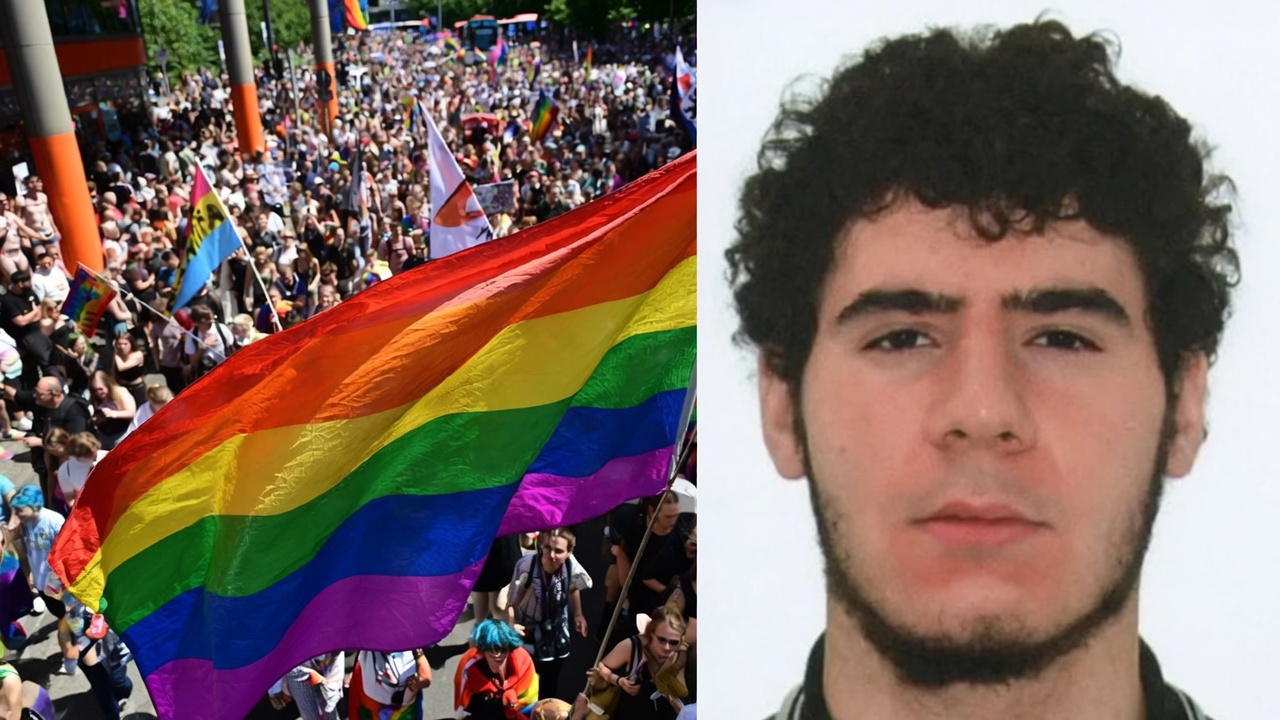
Muslim man rammed his van into a LGBTQ crowd in Berlin
A van was driven into the crowd at Berlin’s Christopher Street Day, killing one woman and injuring at least sixteen others. As a manhunt widens, the case demands care: much is now confirmed, a great deal is not, and the motive remains, by the authorities’ own account, unestablished.
What is known to have happened
For most of Saturday, Christopher Street Day had proceeded as one of Europe’s largest celebrations of its kind — a parade of some eighty trucks winding through central Berlin, drawing hundreds of thousands of participants toward a closing rally and concert at the Brandenburg Gate.
Shortly before ten o’clock in the evening, that day ended abruptly. According to the account Berlin police gave to reporters and to the wire agencies, a white van was driven at speed into a crowd of pedestrians on Lennéstraße, at the edge of the Tiergarten park and only a short distance from where the singer Sarah Connor was performing at the closing event. The vehicle struck several people before colliding with a tree and coming to rest. Its driver — and, police indicated, possibly one or more others — fled the scene on foot.
In the minutes that followed, emergency crews converged on the park. Police used their channels on X to urge the public to leave the area immediately, and the Christopher Street Day festivities, along with the concert, were called off. Investigators later added a detail that complicated the initial picture of a straightforward vehicle-ramming: several people, they said, appeared to have sustained stab wounds, though officials cautioned it was too early to draw conclusions about how those injuries had occurred.
The parade proceeds
Around eighty trucks move through downtown Berlin; hundreds of thousands take part along the route, converging on a closing rally near the Brandenburg Gate.
The van enters the Tiergarten
A white van is driven into the crowd on Lennéstraße at the park’s edge, striking several people before hitting a tree.
The driver flees
One or more people leave the vehicle and escape on foot. Reports of stab wounds among the injured emerge as first responders arrive.
The event is called off
Police clear the area and cancel the festivities and concert. A woman dies at the scene after resuscitation attempts.
The manhunt begins
A search of an apartment in Schöneberg finds no one. By Sunday, police and prosecutors issue a public wanted notice.
One life lost, and sixteen altered
The single fatality was a woman who died at the scene after first responders attempted to resuscitate her. As of the morning after the attack, none of the victims had been publicly named; police established a dedicated telephone line for relatives seeking information. At least sixteen other people were reported injured — three of them with life-threatening injuries and eight severely hurt, according to figures consolidated from police briefings by outlets including CNN and Al Jazeera. Some reporting, including from the Jerusalem Post and Indian wire services, placed the number of injured at seventeen.
The discrepancy is characteristic of the first hours of an event like this one, when casualty figures are revised as the injured are triaged and hospital counts are reconciled. It is the kind of number that should be read as provisional rather than final.
A named man, and a public wanted notice
By Sunday, Berlin police and prosecutors had moved from describing an unidentified assailant to issuing a formal wanted notice. They named a twenty-one-year-old suspect — reported by German and international media as Abdul B. — released a photograph, and asked the public for help locating him, warning that he might be armed and dangerous and that people should avoid direct contact.
Police said the man was already known to them. A spokesman, Florian Nath, characterised him to reporters as someone connected to what he called Islamic, or Islamist, “circles” in the city — the phrasing varied slightly across the German and translated accounts carried by CNN, Reuters, the Associated Press and CBS. An overnight search of an apartment in Berlin’s Schöneberg district, police said, had turned up no one. Reuters and the Washington Post reported, in their Sunday updates, that the named suspect had not been arrested and that the manhunt was continuing.
Reporting on arrests was unsettled at the time of writing. While major wire coverage described the named suspect as still at large, some early accounts referred to detentions that had not been confirmed by police. Where sources conflict on a live investigation, this report treats the unverified claims as exactly that.
Crucially, and in a detail easy to lose beneath the wanted notice, the same police spokesman told reporters that investigators had no information on the suspect’s “specific motives.” A characterisation of a person’s associations is not a statement of why an act was committed — a distinction that becomes the whole of the matter in the section that follows.
Why caution, on motive, is not the same as evasion
An attack on a Pride crowd, attributed to a suspect described as moving in Islamist circles, arrives pre-loaded with an interpretation. The responsible task is to separate what has been established from what is being inferred.
What has been established is narrow. A van struck a crowd; a woman is dead; a named man is being hunted; police have described his known associations; some victims may have been stabbed. What has not been established — by the authorities conducting the investigation — is the motive. Reporting that some investigators are treating the case as a suspected terrorist attack, as several outlets noted, is not the same as a finding that it was one, still less a finding about what any such act was meant to express.
This distinction is not a rhetorical nicety. It is the lesson that recent German cases have taught at considerable cost. When a car was driven into a Christmas market in Magdeburg in December 2024, killing five and injuring more than two hundred, the early framing assumed a familiar template — and then collapsed, because the suspect turned out to be a Saudi ex-Muslim who had built an online profile as a vocal critic of Islam and a sympathiser of the anti-immigration far right. The 2018 van attack in Münster was carried out by a German citizen described by police as psychologically disturbed, with no link to Islamist terror. After the 2016 Breitscheidplatz attack, the first man arrested was released for lack of evidence before the actual perpetrator was identified.
None of this is a reason to suppress what police have said about the suspect’s milieu; it is reported here plainly because it is a matter of public record and public interest. It is, rather, a reason to hold two things at once — to convey the authorities’ characterisation accurately, and to refuse to convert an association into a settled motive, or a single man’s alleged act into a verdict on a faith or its adherents. The investigation, including into the reported stabbings and into whether more than one person was involved, remained open.
The vehicle as a weapon, in a country that has seen it before
The Tiergarten attack enters a grim and specific German lineage: the deliberate use of a vehicle against a crowd. What the record also shows, read honestly, is that these attacks have not shared a single author or a single cause — their perpetrators have ranged from an ISIS-inspired Tunisian to a mentally ill German citizen to an anti-Islam ideologue. The chart below sets the human cost of the most cited recent cases side by side; it is a map of a method, not of a motive.
Vehicle-into-crowd attacks in Germany
An attack framed, immediately, as an attack on the society
The political reaction was swift and, in its language, unified. Chancellor Friedrich Merz called the act despicable and described it as an attack on German society, pledging that it would be fully investigated and punished; his interior minister, Alexander Dobrindt, was named alongside him in that commitment. Berlin’s governing mayor, Kai Wegner, framed the violence as an assault on a free and cosmopolitan city. More than two thousand two hundred officers had been on duty since Saturday morning specifically to protect the Pride events — a figure that underscores both the scale of the celebration and the level of threat the authorities had already judged it to carry.
There is a further dimension that a complete report should name without inflaming it. An attack of this kind, in the current German political climate — one in which the anti-immigration Alternative für Deutschland has continued to register significant electoral support — will be read and used politically, whatever the investigation ultimately concludes. That is a reason for precision, not for silence. The most useful service journalism can render in the first days is to state clearly what is known, mark plainly what is not, and decline to let the gap be filled by whichever narrative is most convenient.
What remains unconfirmed
The motive
Police stated they had no information on the suspect’s specific motives. Whether the attack was ideologically driven, and whether it was aimed at the Pride crowd as such, is not established.
The suspect’s status
Reporting on whether anyone was in custody was contradictory. The named suspect was described in major wire coverage as still at large.
How many were involved
Police indicated one or more people may have fled the vehicle. Whether this was the act of a single individual is unresolved.
The stab wounds
Several victims appeared to have been stabbed. How those injuries occurred, and how they relate to the ramming, is under investigation.
The victims
None of the injured or the woman killed had been publicly identified as of the morning after.
The final toll
Casualty figures remained provisional, with reports of sixteen or seventeen injured and several in critical condition.
Sourcing & method
- Associated Press — wanted notice for the 21-year-old suspect; conduct of the manhunt; Schöneberg apartment search. 26 Jul 2026
- Reuters — police identification of the suspect as a member of Berlin’s “Islamist scene”; not yet arrested. 26 Jul 2026
- CNN — police spokesman on the suspect being known to police; sequence of the ramming. 25 Jul 2026
- NPR — Merz’s characterisation; suspect named as Abdul B.; reports of stab wounds. 26 Jul 2026
- Al Jazeera — casualty figures; Wegner’s statement; the 2,200-officer deployment. 25 Jul 2026
- The Washington Post — Sunday update confirming the suspect had not been arrested. 26 Jul 2026
- CBS News — police account of the suspect’s known associations and Berlin origin. 25 Jul 2026
- Euronews — release of the suspect’s photograph; Lennéstraße location; three in life-threatening condition. 26 Jul 2026
- Jerusalem Post / wire services — alternative injured count of seventeen. 26 Jul 2026
- NBC News · BBC — background on the 2024 Magdeburg attack and its anti-Islam suspect. Dec 2024
Leave a Reply