Analytical Essay
Visiting Paradise and Hell in the Miraj: A Conflict Between Quran and Hadith
The Qur’an places judgment first and punishment after — so how do the scenes of punishment and reward the Prophet witnessed in the Miʿrāj fit that framework? An inquiry into several intellectual questions.
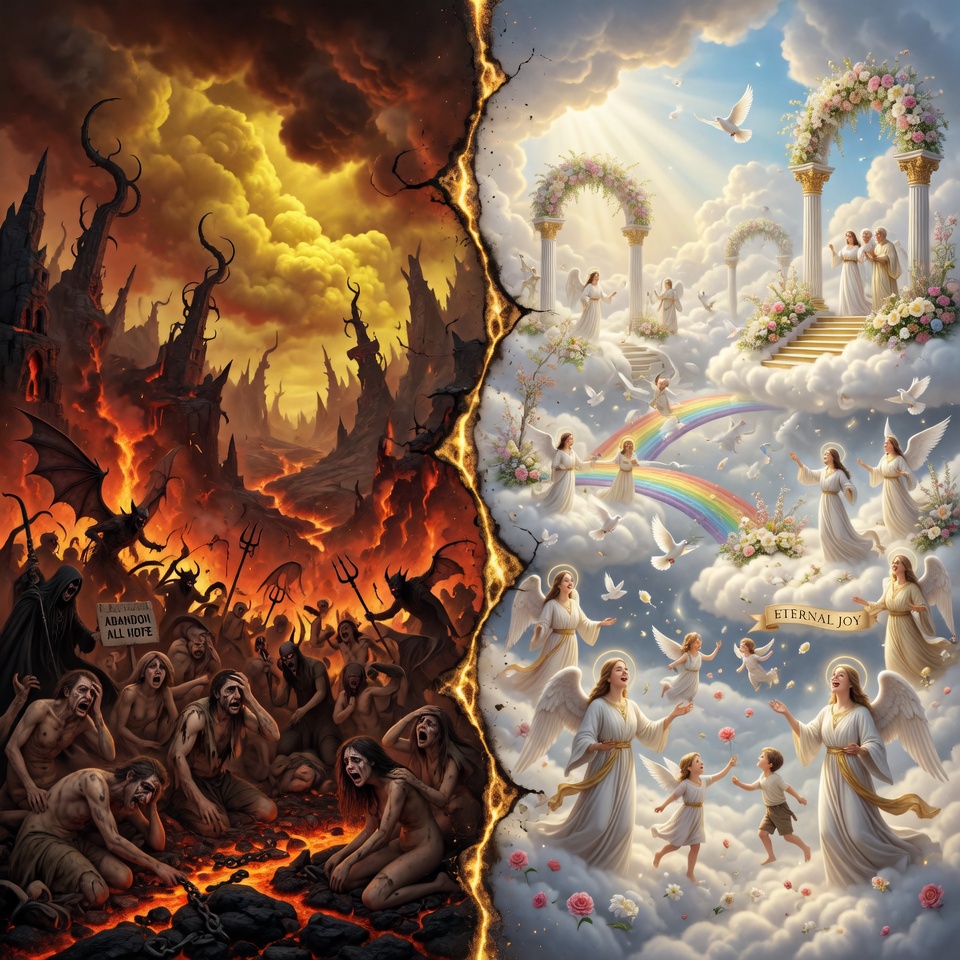
The Miʿrāj is one of the most significant events in Islam. The Qur’an mentions this night journey briefly — that God took His servant by night from the Sacred Mosque to the Farthest Mosque (Qur’an, Surah al-Isra 17:1). According to several reliable hadith narrations, it was during this journey that the Prophet Muhammad witnessed some scenes of Paradise and the punishment of specific sinners in Hell.
These accounts come from the narration of Anas ibn Malik (Sunan Abi Dawud, Hadith 4878; Musnad Ahmad, Hadith 13340), the narration of Ibn ʿAbbas (Musnad Ahmad, Hadith 2324), and Sahih al-Bukhari (Sahih al-Bukhari, Hadith 349). Examined in light of the Qur’an’s conception of judgment, these narrations raise several important questions.
The Punishments of Hell Seen in the Miʿrāj
Several narrations describe the Prophet seeing the punishment of certain sinners in Hell during the Miʿrāj:
- During the ascent he saw people whose nails were of copper, with which they scratched their own faces and chests. Gabriel said these were people who used to backbite and assault the honour of others (Sunan Abi Dawud, Hadith 4878; Musnad Ahmad, Hadith 13340).
- In a more detailed narration by Ibn ʿAbbas, the Prophet looked into Hell and saw people eating corpses or human flesh. The explanation: these too were backbiters (Musnad Ahmad, Hadith 2324).
- In the same narration he saw a man of red-and-blue complexion, short and dishevelled, being punished. Gabriel said this was the man who had killed the she-camel (of the people of the prophet Salih) (Musnad Ahmad, Hadith 2324).
Paradise Seen in the Miʿrāj
On the same journey the Prophet also saw scenes of Paradise. In Sahih al-Bukhari’s narration he met the earlier prophets one by one across the seven heavens — Moses, Jesus, Abraham, and others — who were alive and in conversation there (Sahih al-Bukhari, Hadith 349). After passing Sidrat al-Muntaha he entered Paradise, where he described tents of pearl and earth of musk (Sahih al-Bukhari, Hadith 349). It was on this journey that prayer was made obligatory upon the community — first fifty daily prayers, later reduced to five (Sahih al-Bukhari, Hadith 349).
In other words, the Miʿrāj narration contains both ongoing punishment in Hell and an established state in Paradise.
The Qur’anic Framework: Judgment First, Punishment After
Various verses of the Qur’an state that the final judgment of humankind will take place on the Day of Resurrection. Surah al-Anbiya says that on the Day of Resurrection the scales of justice will be set up (Qur’an, Surah al-Anbiya 21:47). Elsewhere it says that whoever does an atom’s weight of good will see it, and whoever does an atom’s weight of evil will see it (Qur’an, Surah az-Zilzal 99:7–8).
More explicitly, the Qur’an says recompense is paid in full only on the Day of Resurrection — every soul shall taste death, and only on the Day of Resurrection will deeds be repaid in full (Qur’an, Surah Aal-Imran 3:185). Even the scene of entering Paradise and Hell comes after judgment — once the reckoning is complete, the disbelievers are driven to Hell in groups and the God-fearing to Paradise in groups, and only upon arrival are the gates opened (Qur’an, Surah az-Zumar 39:71–73).
On the basis of these verses, a general framework of Islamic belief emerges:
- Worldly life
- Death
- Resurrection (Qiyamah)
- Judgment
- Paradise or Hell
That is, the final reward or punishment is supposed to take effect only after judgment is complete.
First Question: How Can There Be Punishment Without Judgment?
Here the first fundamental question arises.
If, according to the Qur’an, the final judgment takes place on the Day of Resurrection (Qur’an, Surah al-Anbiya 21:47), then when did the punishments seen in the Miʿrāj begin?
The Miʿrāj took place during the Prophet’s lifetime — long before the end of the history of the world. The Resurrection had not yet occurred then, and has not occurred to this day. Yet the narrations show certain people already actively suffering punishment in Hell (Sunan Abi Dawud, Hadith 4878; Musnad Ahmad, Hadith 2324). So how did they come under punishment before the final judgment was carried out?
If it is said these are pre-Resurrection punishments, the question arises: where then does the central importance the Qur’an gives to the Day of Judgment stand? If judgment is merely a later, formal step, it is natural to question its function.
Second Question: Who Are the People Being Punished?
In earlier discussion the question was whether the punished people are of the past, the future, or symbolic. The narration of Ibn ʿAbbas sharpens this question.
Because there, at least one is specifically identified — the man who killed the she-camel of the prophet Salih’s people (Musnad Ahmad, Hadith 2324). This man was of the people of Thamud — that is, a man who died many centuries before the birth of the Prophet Muhammad. Yet during the Miʿrāj he is shown in a state of punishment.
This leads to the question: if a specific sinner of the past is seen in active punishment before the final judgment, then what does the final judgment of the Resurrection actually add? If punishment has already begun, what is the distinct role of the Day of Judgment?
Future People and Free Will
On the other hand, categories such as backbiters (Sunan Abi Dawud, Hadith 4878) are not confined to people of the past; such sins occur in every age and will occur in the future. So how can the punishment of people who had not yet been born — whose offences had not yet been committed — be shown as already predetermined?
Here a philosophical problem of free will and predestination arises. If future actions are already certain and unchangeable, how real is the scope of human free choice?
The Barzakh Explanation and Its Problem
Many Islamic thinkers and scholars, in explaining this apparent inconsistency, say these are not the final punishment of Hell but the punishment of the barzakh. The Qur’an says that behind the dead is a barzakh until the Day of Resurrection (Qur’an, Surah al-Mu’minun 23:100). According to this explanation, some people experience punishment in the intermediate state between death and resurrection.
But here too a question remains. The barzakh is generally explained as the intermediate state of the grave. Yet in Ibn ʿAbbas’s narration it is explicitly said that the Prophet saw these punishments by “looking into Hell” (Musnad Ahmad, Hadith 2324). That is, the text places the scenes in Hell, not in the intermediate state of the grave. So are these experiences of the barzakh, or an early form of Hell? The language of the hadith does not always make this boundary clear.
Is Reward, Too, Before Judgment?
The Miʿrāj adds a new dimension to our discussion. Not only punishment — the image of reward, too, is present there before judgment.
In the actual Miʿrāj the Prophet sees the earlier prophets alive, active, and conversing across the seven heavens, and he himself enters Paradise (Sahih al-Bukhari, Hadith 349). But at the time of the Miʿrāj the Resurrection had not occurred, nor had the final judgment been carried out.
So how were these prophets already established in their honoured stations before judgment? That is, in the Miʿrāj we see on one side an image of punishment before judgment (Sunan Abi Dawud, Hadith 4878), and on the other an image of being rewarded and stationed before judgment (Sahih al-Bukhari, Hadith 349). Both sides of the afterlife — punishment and reward — appear to be in effect before the Qur’an’s central Day of Judgment. If so, where exactly lies the distinct role and necessity of the final judgment?
Another Question: Omniscience and the Bargaining Down of the Prayers
The matter of prayer in the Miʿrāj raises a separate philosophical question.
According to the narration, God first made fifty daily prayers obligatory, and through Moses’s repeated advice — at the Prophet’s request — it was reduced step by step until it finally became five. God says these are five prayers but equal to fifty in reward, because His word does not change (Sahih al-Bukhari, Hadith 349). Several questions arise from this.
First, if the omniscient God already knew the community could not bear fifty prayers, why was it necessary to first make fifty obligatory and then reduce it step by step?
Second, the ruling effectively changed several times (from fifty down to five), yet in the same narration God says His word is unchangeable (Sahih al-Bukhari, Hadith 349). Notably, this sentence of the hadith almost exactly echoes a verse of the Qur’an — “the word is not changed with Me” (Qur’an, Surah Qaf 50:29). That is, at the very moment the number of prayers is changing from fifty to five, God is pronouncing the principle of the unchangeability of His word. Between the number changing and “the word does not change,” an apparent inconsistency remains.
Third, here a human prophet (Moses) is portrayed as showing more realism about the community’s capacity than God’s initial command. How is this account — of an omniscient being’s command being repeatedly revised on a prophet’s advice — consistent with the idea of the completeness and immutability of divine knowledge?
Common Objections and Brief Responses
Against this discussion several objections are usually raised. Two important objections and their assessment follow.
Objection 1: The Qur’an itself mentions punishment before judgment. Of the followers of Pharaoh it is said that they are exposed to the Fire morning and evening, and on the Day of Resurrection they will be made to enter the severest punishment (Qur’an, Surah Ghafir 40:46). So a form of punishment before judgment is Qur’anically affirmed.
Assessment: This verse, rather than resolving the objection, actually sharpens the central question. For the Qur’an on one side says final recompense is only on the Day of Resurrection (Qur’an, Surah Aal-Imran 3:185), while on the other it gives an image of punishment before judgment (Qur’an, Surah Ghafir 40:46). If punishment is already in effect, then what does the scale of justice on the Day of Resurrection (Qur’an, Surah al-Anbiya 21:47) add — this question remains.
Objection 2: The martyrs are alive and rewarded before judgment. The Qur’an says: do not think those slain in the way of God are dead; rather they are alive, provided for by their Lord (Qur’an, Surah Aal-Imran 3:169). Therefore, for some, reward may begin even before judgment.
Assessment: This is a reasonable counter-argument, and it parallels the matter of seeing the prophets stationed in the heavens during the Miʿrāj. But here too that same verse stands in the way — the Qur’an says full recompense is reserved for the Day of Resurrection (Qur’an, Surah Aal-Imran 3:185). Moreover, the scenes seen in the Miʿrāj — active physical punishment in Hell, fire, opened gates — are closer to the image of the final Paradise and Hell than to the ordinary conception of the barzakh. So the boundary remains unclear.
Conclusion
The aim of this discussion is not to impose a conclusion, but to raise several intellectual questions.
There has long been debate over the relationship between the Qur’an’s conception of post-judgment punishment and the scenes of punishment and reward described in the Miʿrāj. Islamic theology has offered various explanations, but those explanations too give rise to new questions:
- How is punishment in Hell carried out before judgment even begins (Sunan Abi Dawud, Hadith 4878; Musnad Ahmad, Hadith 2324)?
- If a specific sinner of the past is seen in punishment before judgment (Musnad Ahmad, Hadith 2324), what does the final judgment add?
- If the categories of sinners include future, unborn people too, where is the place of free will?
- If punishment is shown in Hell, how does it fit the barzakh explanation?
- If the prophets are established in Paradise before judgment (Sahih al-Bukhari, Hadith 349), has reward, too, begun before judgment?
- How consistent is the bargaining down of prayers from fifty to five (Sahih al-Bukhari, Hadith 349) with the ideas of omniscience and immutability?
When religious narration is examined with a critical and analytical eye, many such questions come to the fore whose answers remain long debated. And it is those very questions that create new ground for thought, inquiry, and discussion.
Sources
- Sunan Abi Dawud, Hadith 4878 — narrated by Anas ibn Malik; during the ascent, the punishment of backbiters scratching their faces and chests with copper nails (hasan/sahih)
- Musnad Ahmad, Hadith 13340 — narrated by Anas ibn Malik; a parallel narration of the above
- Musnad Ahmad, Hadith 2324 — narrated by Ibn ʿAbbas; the punishment in Hell of backbiters and the she-camel’s killer, and the meeting with Abraham (grading disputed: Ibn Kathir / Shakir / Suyuti — sahih; al-Arnaʾut — weak)
- Sahih al-Bukhari, Hadith 349 — Kitab as-Salat; meeting the prophets in the Miʿrāj, entering Paradise, and the reduction of prayers from fifty to five
- Qur’an — Surah al-Isra 17:1; Surah al-Anbiya 21:47; Surah az-Zilzal 99:7–8; Surah Aal-Imran 3:185 and 3:169; Surah az-Zumar 39:71–73; Surah al-Mu’minun 23:100; Surah Qaf 50:29; Surah Ghafir 40:46
Leave a Reply